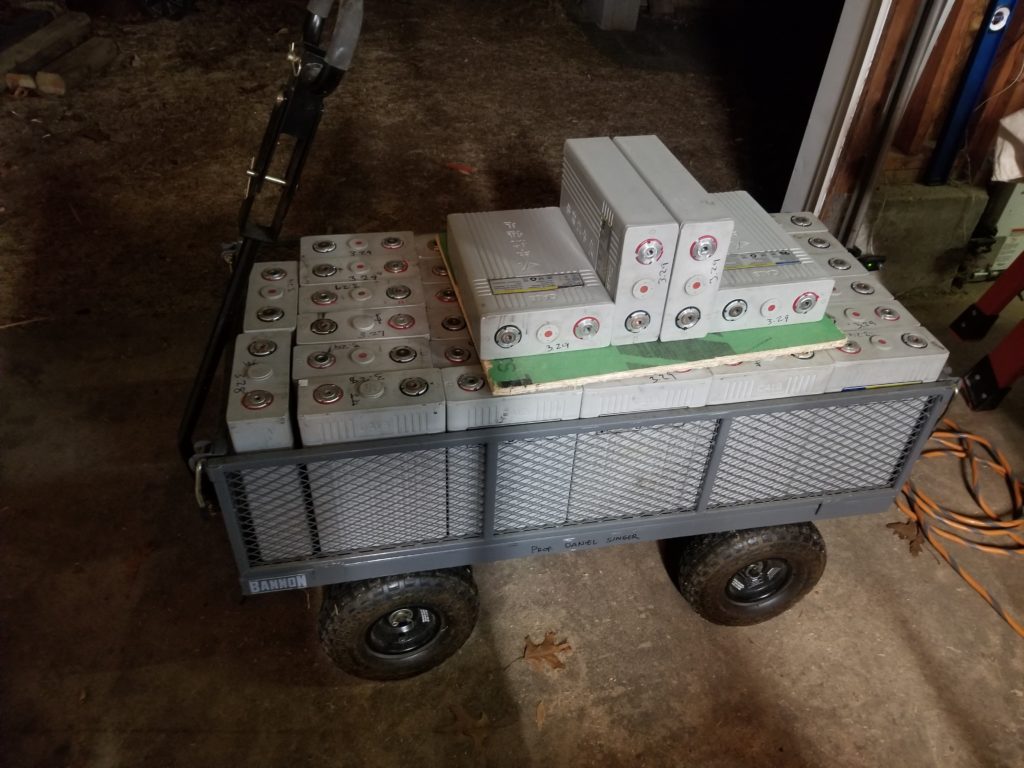
By dark of night, this little garden wagon carries into the garage a nominal 20kWh of energy storage, recently liberated (paid for fair and square) from a race car and hauled home in the back of the White Ravvit, whose cargo space didn’t much care for the weight (nearly 450#) concentrated on the six landing pads of the crate, but nevertheless escaped with only minimal, concealed damage.
These units are definitely used, but are expected to have most of their service life remaining. Being a race car power source is a new battery’s game. After not-that-long, even the slightest reduction in performance starts to matter and the cells must be traded out for fresh ones, even though they would be happy to keep on working at 80% or better for some time. That kind of performance is totally good enough for me… and that’s why they’re here. That, and buying these saves me at least 50% over the cost of something new for the same capacity, even factoring in all the accouterments I need to add (including the BMS, discussed below).

If you’re in no mood for highly technical talk, you might as well bail out now.
So there I was, contemplating Battery Management Systems (widgets which monitor individual cell voltages for being within safety ranges and which can cut-out the battery bank if something goes wrong, voltage-wise or temperature-wise) and wondering: hm, what do I suppose is the power requirement of the BMS itself? The user manual didn’t say, and given that it’s a little computer doing a little bit of computing, it probably weighs in at about 5W. Small potatoes. But then I got to thinking, the real energy draw is probably not the BMS, but the high-current relays that it uses to cut out the battery bank. The documentation says the standard relays consume up to 10W each. I’d need 8 of them. Running all day, that’s 8 x 10W x 24h = 1920Wh. My whole day’s energy budget is 3500Wh, before thinking about these relays. Put another way, the relays would eat more than half my day’s energy budget. NO BUENO! So glad I checked.
I really do want the emergency cut-out features but I can’t afford half my energy budget to keep those relays on while there’s no emergency! I then remembered, from long, long ago when my engineering degree was fresh and my electronics hobby was active, that there are these things called “solid state relays” which use far less energy than their electromechanical counterparts. And by far less, I mean 180mW vs 10W. That’s less than 1/50th the power. 4.3Wh each per day. Even if I had 8 of them, that’s 34Wh, or just about 1% of my budget. That I can handle.
Now the question is, can I find SSRs that can handle 200 Amps DC that may change directions (charging one way, running off battery the other way)? That’s the big question and I’ve already started shopping. The SSRs that seem to be in the right class are about $200 each. Not exactly chump change, especially if I need 8 of them, but what’s the price of not burning down my house? Right. $200 x 8 doesn’t seem unreasonable. I’m still way ahead cost-wise on my battery system. And I can probably set it up to need only 4 if I add a little minor circuitry (<$10) of my own.
There are definitely things I need to know that I do not yet know about how to shop for these — like I said, it’s been quite a long while since I did any electrical engineering and when I did, I never used these things and the things I did use were at like 10% the carrying capacity of what I’m shopping for now. This is a whole different class of widget. I have sought some professional guidance. I know enough to know I don’t know enough to do this part without a little help.
Where does that 200A come from? Well, my inverter maxes out at 4kW. That corresponds to 167A at 24V, my battery bank nominal voltage. Add a little margin and there ya go, 200A. I do not actually expect to draw 4kW all at once and certainly not from just one battery bank (there will be four), but from a safety standpoint, a design goal of accommodating the worst possible case is prudent. That case is the inverter is pulling max current and only one battery bank is actually connected. That case has not not catch fire, eh? Right. That’s where the 200A rating come from.
Update 2020-03-04 – It has occurred to me that there’s no good reason I need to use 4 banks at 24V nominal. I could just as well use 2 banks at 48V nominal. This cuts these things in half: max current and the number of bank-related things I need (BMS + cut-out relays + cabling/connectors). It means I need a 48V power inverter instead of a 24V one, but the price differential is less than $200, easily offset by the savings elsewhere. Actually, things get considerably simpler and less expensive with two banks.
Update 2020-03-05 – Actually, I can count on the inverter to cut itself off on low battery voltage, so all I need for cut-outs is actually just two relays, one for each bank’s over-voltage protection as directed by the BMS. Good. Still, those 10W relays will never do, as even just two of them, running all day, is 12% of my energy budget. And then there’s the inverter itself, which I hadn’t really thought about until today. That thing will burn 40W on its own, costing me nearly 1kWh a day. That’s a big chunk of my budget – but then I realized some other numbers were wrong (I actually measured my laptop’s typical consumption which is about 1/4 what the power brick is rated for — which must accommodate peak consumption AND battery charging). So after spending some time back at the power budget spreadsheet, adjusting for a new reality, I come to the conclusion that my worst case energy usage is 3.6kWh/day in the middle of winter, not the 3kWh I thought before, so the new design target is 4kWh. Okay, not a big deal – just another solar panel on the rack maybe. Those nice lithium batteries will still get me through 3 days of zero solar generation or rather a lot of not-bright-enough days. And if even that’s not enough, there’s always a backup generator as a last resort. All these numbers are ex rectum anyhow. There were a lot of estimates in there for things like pumps and blowers and what-not. I won’t really actually know how the system performs until I really actually use it. As Kirk used to say, “Best guess, Mr. Sulu”. Indeed.